
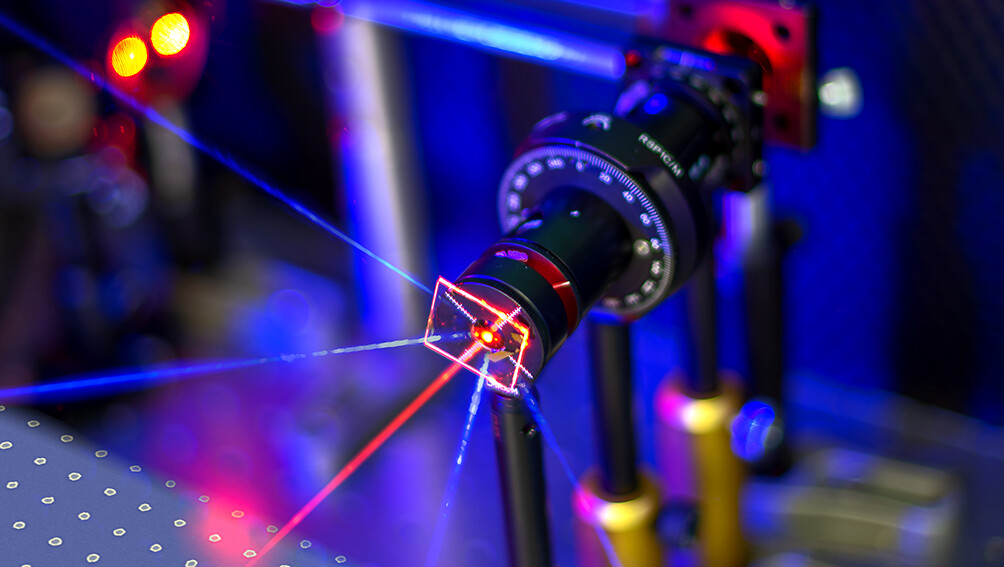
The sensor is made up of a series of gold disk-shaped nanoparticles on a glass slide. The team at Bath discovered that when they shone an infra-red laser at a precise arrangement of the particles, they started to emit unusual amounts of ultra violet (UV) light.
This mechanism for generating UV light is affected by molecules binding to the surface of the nanoparticles, providing a means of sensing a very small amount of material.
The researchers, from the VR成人视频鈥檚 Department of Physics, hope that in the future they can use the technology to develop new ultra-sensitive sensors for air pollution or for medical diagnostics.
Dr Ventsislav Valev, Royal Society Research Fellow and Reader in Physics at the VR成人视频, led the work with Research Associate David Hooper.
He explained: 鈥淭his new mechanism has great potential for detecting small molecules. It is 100 times more sensitive than current methods.
鈥淭he gold nanoparticle disks are arranged on a glass slide in a very precise array 鈥� changing the thickness and separation of the disks completely changes the detected signal.
鈥淲hen molecules bind to the surface of a gold nanoparticle, they affect the electrons at the gold surface, causing them to change the amount of UV light they emit.
鈥淭he amount of UV light emitted would depend on the type of molecules that bind to the surface.
鈥淭his technique could enable ultra-sensitive detection of molecules in tiny volumes. It could in the future be used for detecting very low concentrations of biological markers for the early diagnostic screening for diseases, such as cancer.鈥�
The study has demonstrated the proof of principle for this new sensing mechanism. The team would next like to test the sensing of various types of chemicals and expects the technique to be available to other scientists to use within five years.
The nanoparticles were fabricated by researchers at Northwestern University, Illinois (USA).
David C. Hooper, Christian Kuppe, Danqing Wang, Weijia Wang, Jun Guan, Teri W. Odom, and Ventsislav K. Valev (2018) 鈥淪econd Harmonic Spectroscopy of Surface Lattice Resonances鈥� is published in DOI: 10.1021/acs.nanolett.8b03574